

Fill-level sensor — collect by actual fill level, not by the calendar
How a sensor measures the level of waste, what it cannot measure, and when fitting one actually pays off.
The truck comes on Wednesday. But how do you know that Wednesday is actually the right day to empty this particular bin? Usually, the answer is simple: because that is what the collection schedule says. Once a week, every other week, every Monday.
That works as long as waste volumes are reasonably predictable. The problem starts when they are not. One week, a bin may be almost empty. The next, it may fill up much faster — holidays, the tourist season, a local event or a change in the number of residents can all change the rate at which waste accumulates.
The calendar cannot see that. And the bin will not tell you that it is going to be full in three days. The operator is therefore left with two imperfect choices: collect too early, or risk collecting too late.
Two mistakes, two different costs
| Collecting too early | Collecting too late | |
|---|---|---|
| What you see | A bin that is only one-third full | Waste piling up beside the bin |
| Who reports the problem | Nobody | Residents, the property manager, sometimes the municipality |
| What it costs | The full cost of the collection run: fuel, vehicle time, driver and crew | Clean-up, additional collection, complaints and staff time |
Collecting too early is easy to overlook. The truck arrives, the waste is collected, the vehicle moves on and nobody complains. But the collection run cost essentially the same as it would have if the bin had been full.
The second mistake is much more visible. That is why collection schedules are often built with a safety margin — it is better to arrive a little early than risk an overflowing bin.
The problem is that this safety margin also has a cost. It is simply less visible.
Instead of guessing when a bin will be full, you can measure its actual fill level.
What does a fill-level sensor actually measure?
A fill-level sensor does not look inside the bin or identify the type of waste. It measures the distance between the sensor and the surface of the waste — in our solution, using Time-of-Flight technology. The shorter the distance, the less free space remains.
This is not simply a single-point measurement. The device analyses the signal across its field of view, so a single cardboard box sticking up underneath the lid does not automatically make the system report the bin as full.
There is another important distinction: the sensor measures fill level, not the weight of the waste. A bin filled with lightweight material may show a high fill level while weighing relatively little. The sensor does not replace a weighing system — it solves a different problem. It tells you how much space is left.
A bin does not have to be full to need emptying
There is no need to wait until the fill level reaches 100%. The operator can define their own thresholds — for example, 80% could mean "schedule collection" and 90% could mean "collection required soon".
The exact thresholds depend on the type of waste, the container and the operator's chosen operating model. The principle is what matters.
The system therefore does not have to answer only the question, "Is the bin full?" It can answer a much more useful one: is the bin approaching the point where it needs to be emptied?
Instead of driving out to check — check remotely
Without a sensor, the fill level can only be checked on site. For a single location, that may not be a problem. With dozens or hundreds of bins, however, every trip made simply to look inside a container comes at a cost — even though the vehicle does not collect anything.
A fill-level sensor moves that task to the platform. The operator can check the status of multiple bins remotely, without driving between locations. When the system reports that a threshold has been exceeded, the operator knows exactly which locations require attention.
You do not have to check every bin. You can focus on the ones that actually need it.
Not just the current level — the history matters too
A single measurement tells you relatively little. The real value comes from the history. When the system records fill levels over several months, you can see how quickly individual bins fill up.
You may find that:
- one bin needs to be emptied every few days,
- another comfortably lasts several weeks,
- a third fills up very quickly only during certain periods,
- a fourth remains almost empty most of the time.
A collection schedule alone cannot provide this information. The data can help you plan not only the next collection, but also how individual collection points are serviced over time.
What does this change in the collection schedule?
The idea is not to eliminate the collection schedule. It may still be necessary. The difference is that the schedule no longer has to be the only source of information.
The principle is simple: fixed schedule + actual fill level.
If a bin is filling faster than usual, you can respond earlier. If it is filling more slowly, there may be no reason to collect it simply because a certain number of days has passed.
Where does a fill-level sensor make the biggest difference?
Not every bin needs to be monitored. If a container is located right next to the operator's depot and can be checked with virtually no additional effort, the benefit may be limited.
There are, however, situations where remote monitoring can make a significant difference:
- Collection points spread over a large area. When bins are distributed across many towns and locations, the travel required just to check them becomes significant.
- Underground and semi-underground containers. Their fill level cannot easily be assessed from the outside — the lid has to be opened.
- Locations with highly variable waste volumes. Seasonal destinations, markets and areas around schools are examples where a fixed schedule can be particularly inaccurate.
- Large numbers of containers. The more locations there are, the less practical it becomes to inspect each one individually.
What can and cannot a fill-level sensor do?
It is worth being clear about this.
| The sensor can | The sensor cannot |
|---|---|
| Measure fill level | Identify the type of waste inside |
| Send data to the platform | Determine whether waste has been sorted correctly |
| Store measurement history | Weigh the contents of the container |
| Report when thresholds are exceeded | Plan an entire collection route by itself |
| Support collection planning based on actual fill levels | Make the container fill up more slowly |
The last point is particularly important. A fill-level sensor does not reduce the amount of waste. It simply provides information about what is happening inside the container. That information can then be used to make better operational decisions.
What about battery life and connectivity?
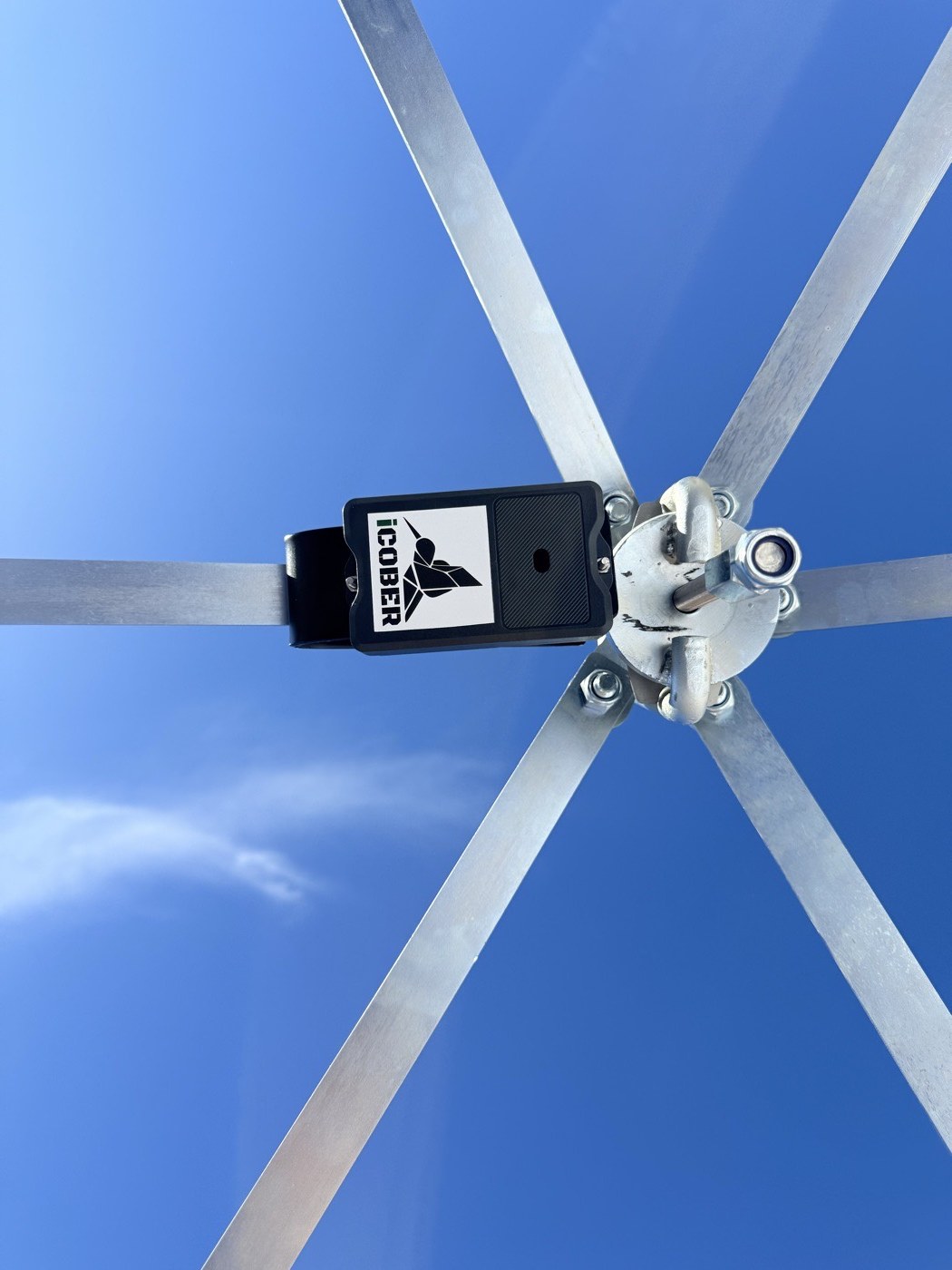
A device designed to operate for years cannot be treated like equipment connected to a mains power supply. That is why the iCober Bin Sensor is designed for battery-powered operation. Depending on the configuration and measurement frequency, battery life can reach up to 10 years.
For data transmission, the device uses NB-IoT or LTE-M cellular connectivity — LPWA technologies designed for devices that spend most of their time in a low-power state and periodically transmit small amounts of data.
This means there is no need to provide a permanent power supply at the container or build dedicated communications infrastructure.
For the operator, however, the most important point is simpler: the device is designed to work in the background, without requiring attention simply to provide information about the container's fill level.
Three questions to ask before installing sensors
Before installing sensors, it is worth calculating three things.
- What does one unnecessary collection run cost? Not just fuel, but also vehicle time, driver time and crew time.
- What does an overflowing container cost? Clean-up, additional collections, complaints, interventions and staff time.
- What does it cost to check a container on site? Next to the depot, very little. As part of a route covering a dozen or more locations, potentially much more.
These three figures will give you a much clearer picture of whether the solution actually makes economic sense.
The most important change is a simple one
A collection schedule answers the question: "When do we normally empty this container?"
A fill-level sensor lets you answer a different question: "What is its actual fill level now, and when will it really need to be emptied?"
This is not a revolution. The truck still has to arrive. The container still has to be emptied. Waste is still produced. What changes is how the collection decision is made.
And the more containers you operate, and the further apart they are, the more valuable it becomes to know their actual fill levels without having to drive from one location to another.
Instead of assuming a container is full, you can measure it.
Do you see garbage trucks in your neighbourhood making trips to containers that are barely full? Write to us — we'll be happy to look at how many of those trips could be avoided.
How measurement changes collection planning is on the collection by fill level page. How the device itself works: Fill-level sensor. On measurement in underground containers, see Underground containers.