
 From an idea to a finished solution
Access control and fill-level monitoring for waste containers
We design and build systems for access control and fill-level monitoring of waste containers, as well as bespoke IoT devices to order. We combine electronics, software and wireless connectivity into one coherent system.
One system. Four different needs.
The same hardware meets different needs depending on who uses it.
 Municipalities
Billing based on actual use
Authorised residents have access. Every opening is recorded and monitored, so billing can rest on actual use of the container rather than on declarations alone.
See more →
 Waste operators
Collection by fill level, not by a schedule
Fill-level measurement shows which containers need emptying. That cuts needless trips to partly empty containers, reduces fuel use and CO₂ emissions, and lowers the risk of overflow.
See more →
 Property managers
Preventing unauthorised waste disposal
A bin store or a waste container open only to the building's residents, not to passers-by from outside. Less unauthorised waste, and fewer disputes over who should pay for it.
See more →
 Container and system manufacturers
Our electronics inside your product
We supply access-control and fill-level measurement modules for integration into your products — together with technical support.
See more →
Hardware in the container. A system to manage it.
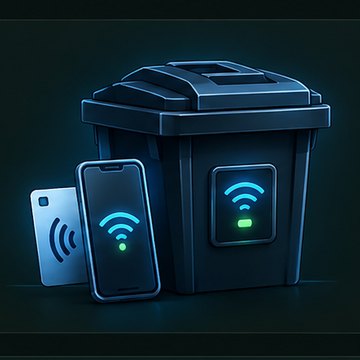
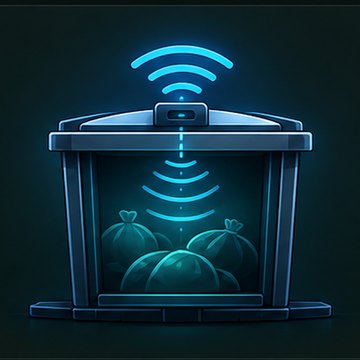
From electronics and firmware to the app and the operator platform — the key parts of the system are developed at iCober, by one team.
iCober Cloud + Key
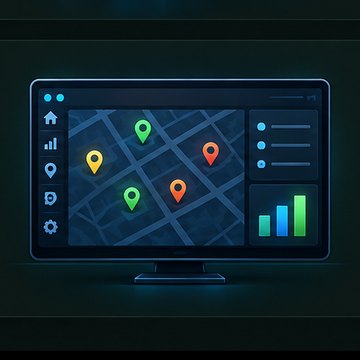
Data, permissions and the running of the system, in the operator panel and the mobile app.
See iCober Cloud live →25 simulated devices · 30 days of history · no sign-upExplore the map → check fill levels → view access history and alarms
Retrofits into the containers you already have
Our devices turn an existing container into a smart container, and a bin store into a smart bin store — with access control, fill-level measurement or both. Without replacing the whole infrastructure.

No new containers needed
The new functions go onto what is already in place. Whether a fit is possible depends on the container's construction — how the lid opens and where the reader can sit. Photos and dimensions settle it fastest.

No power supply to run
The devices run on battery and connect over the cellular network, while access control in the Offline version works even without coverage. No cables to lay, no installation to build.

Where it makes sense
Fill-level measurement and access control can start at selected locations, and the system can grow step by step.
Fewer journeys, lower CO₂ emissions

Collection based on the actual fill level
Fill-level measurement shows which containers actually need emptying. Every run that can be avoided is fuel not burned and CO₂ not emitted.

Rewarding instead of penalising
Every opening is recorded and tied to a particular user. That helps raise awareness of correct waste sorting and encourages residents to develop better habits. Instead of penalising mistakes, the system allows rewarding people for sorting correctly.

The resident sees their own result
The iCober Key app shows how the user sorts their waste — the share of each waste fraction and the estimated CO₂ saving associated with their sorting*.
The figures shown in the app are estimates. They are calculated from per-fraction coefficients, on an assumed figure of roughly 4 kg of waste per opening. The coefficients rest on data from Turner et al. (2015, Resources, Conservation and Recycling) and Scientific Reports (2023). The results are not a measurement of the actual effect of a deployment.
Deployments in service
Our solutions are already running in Poland, Croatia, Bosnia and Herzegovina, and the Netherlands. Demonstration units are also available with partners in Norway and Sweden.

Fill-level measurement across the whole network, access control only where it solved a real problem. Not every container needs a lock.
Read more →
Access control designed around a specific container layout. In Soesterberg, the system was configured to fit the existing infrastructure.
Read more →
A multi-fraction bin store with a separate button to activate the system. One device controls access to several waste fractions.
Read more →
Fill-level measurement and access control where the infrastructure is still being built. No power or network connection has to be brought to the site.
Read more →
Access control and fill measurement on one textile container. The deployment shows the system is not tied to one kind of container.
Read more →
Access control and fill measurement at a single collection point. Several users, shared containers, and data that makes collection easier to plan.
Read more →
The client already had collection schedules and vehicles; what was missing was data. The system shows fill levels and confirms that a container was emptied.
Read more →From a conversation to a working system
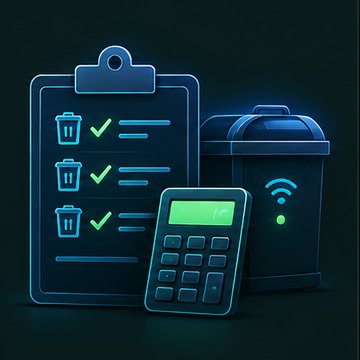
Four steps, with no surprises along the way.

Conversation
You tell us how many containers you have, where they are and what you need.
Selection and quote
We match the solution to the coverage, power and mounting conditions. You receive a clear quote.
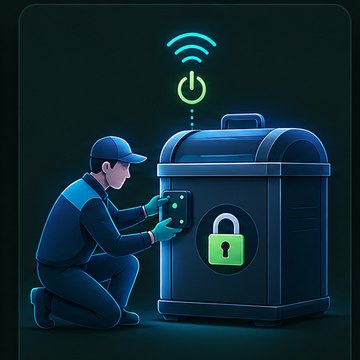
Installation
Mounting on the containers, system configuration, and access switched on for residents.
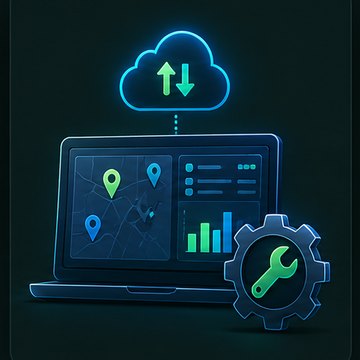
Operation
We provide technical support, servicing, and remote updates of permissions and software.
Got an idea? Let's talk.
Do you need a ready solution for access control or container monitoring? Or a partner to design an IoT device of your own? We do both — from electronics and software to deployment. Tell us what you need.