

Time-of-Flight or ultrasonic — how to measure how full a bin is
Ultrasonic or Time-of-Flight for waste container fill level? What really decides: container geometry, waste type and installation position.
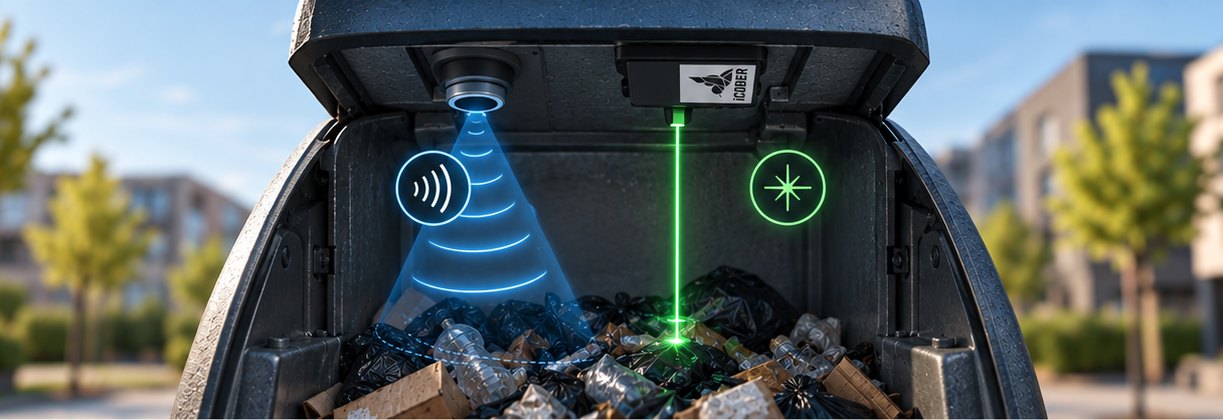
A fill-level sensor does not weigh waste and it does not "see" how many kilograms are inside a container. It does something much simpler: it measures the distance between the sensor and the surface of the waste. The shorter the distance, the fuller the container.
Several technologies can be used for this measurement. Two common approaches are ultrasonic sensing and optical Time-of-Flight (ToF).
The basic idea is similar: send a signal towards the waste and use the returned signal to determine the distance. The difference is the type of signal. Ultrasonic sensors use acoustic waves. Time-of-Flight uses light.
That difference affects how the sensor behaves inside a real waste container.
A cone versus a narrower measurement area
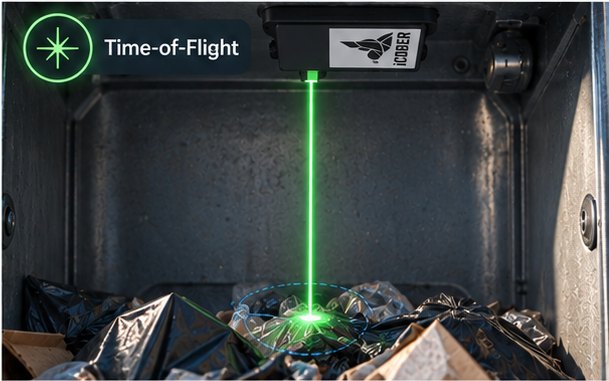
This is one of the most important practical differences.
Ultrasound propagates within a defined beam pattern. As the distance from the sensor increases, a larger area can fall within that beam. The actual beam width depends on the transducer and sensor design.
If a protruding bag, part of the container structure or another obstacle produces a strong echo within this area, it can affect the result.
Optical ToF sensors do not measure a perfect mathematical point either. They have a defined Field of View (FoV) that depends on the sensor and its configuration.
However, this field can be relatively narrow and, in some sensors, further controlled using a Region of Interest (ROI). This makes it easier to direct the measurement towards the part of the container where we actually want to measure the waste surface.
That matters because waste almost never forms a perfectly flat surface.
Why container geometry matters
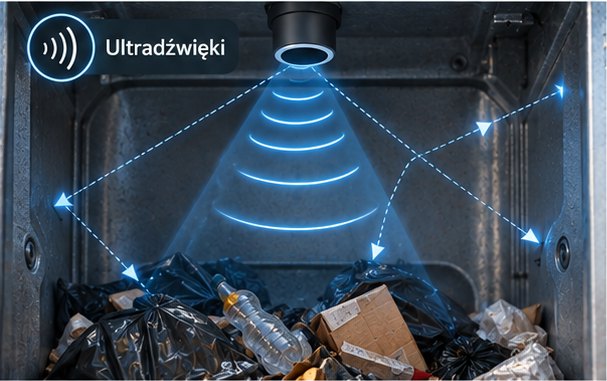
A sensor inside a real container is not operating in an empty laboratory. There are walls, brackets, edges, structural components and the waste itself.
With ultrasound, these objects can create additional echoes. This is why ultrasonic sensor manufacturers pay close attention to installation position, beam pattern and obstacles within the sensing area.
The effect can be particularly relevant in metal containers because hard surfaces are good acoustic reflectors.
This does not mean that ultrasonic sensors cannot work in metal containers. A correctly selected sensor, good mounting position and appropriate signal filtering can produce very good results. It does mean that the geometry of the container can have a significant influence on measurement quality.
With optical ToF, it is often easier to restrict the observed area and direct the measurement towards a specific part of the waste.
What else affects ultrasonic measurements
Surface properties. Soft, porous or irregular materials can produce weaker or more diffuse acoustic echoes than hard, flat surfaces. For a textile collection container, this is not an edge case — it is the normal operating condition.
Temperature. The speed of sound in air changes with temperature. An accurate ultrasonic system should therefore account for this effect or provide suitable compensation.
Obstacles. A structural component inside the sensor's beam can become a measurement target. Sensor placement is therefore just as important as sensor selection.
Weak or multiple echoes. The processing algorithm must determine which received signal corresponds to the actual waste surface. In complex geometries, that is not always obvious.
ToF has limitations too
Time-of-Flight is not free from limitations. Optical ToF performance depends on factors including target reflectance, ambient light, contamination of the optical window and the sensor's field of view.
A poorly reflecting target can reduce the useful maximum range. Strong light directed at the sensor can also make ranging conditions more difficult.
Inside a closed container, direct sunlight is usually less significant than in an open environment, but installation geometry still matters.
There is therefore no technology that can universally be called the best. What matters is the complete system: the sensor, the container, the waste type, installation position and data processing.
Do not compare technologies with one number
It is easy to find tables claiming a particular percentage accuracy for ultrasound and another for ToF. Such comparisons are usually too simplistic: specifications belong to a particular sensor tested under a defined set of conditions, not to an entire sensing technology.
For waste containers, it is more useful to compare the characteristics that affect real installations:
| ultrasonic | Time-of-Flight | |
|---|---|---|
| measurement medium | acoustic wave | light |
| measurement area | wide, set by the shape of the beam | narrower — the sensor looks at a chosen part of the interior |
| objects in measurement area | produce extra echoes that must be told apart from the waste | matter only if they stand in the path of the beam |
| air temperature | affects speed of sound | does not affect measurement in the same way |
| low optical reflectance | generally not relevant | can reduce usable range |
| ambient light | not relevant to acoustic principle | can affect performance |
| metal walls | can create acoustic reflections | no acoustic reflections |
What we chose, and why
The iCober Bin Sensor uses Time-of-Flight. Not because ultrasonic sensing is a bad technology — it works very well in many applications.
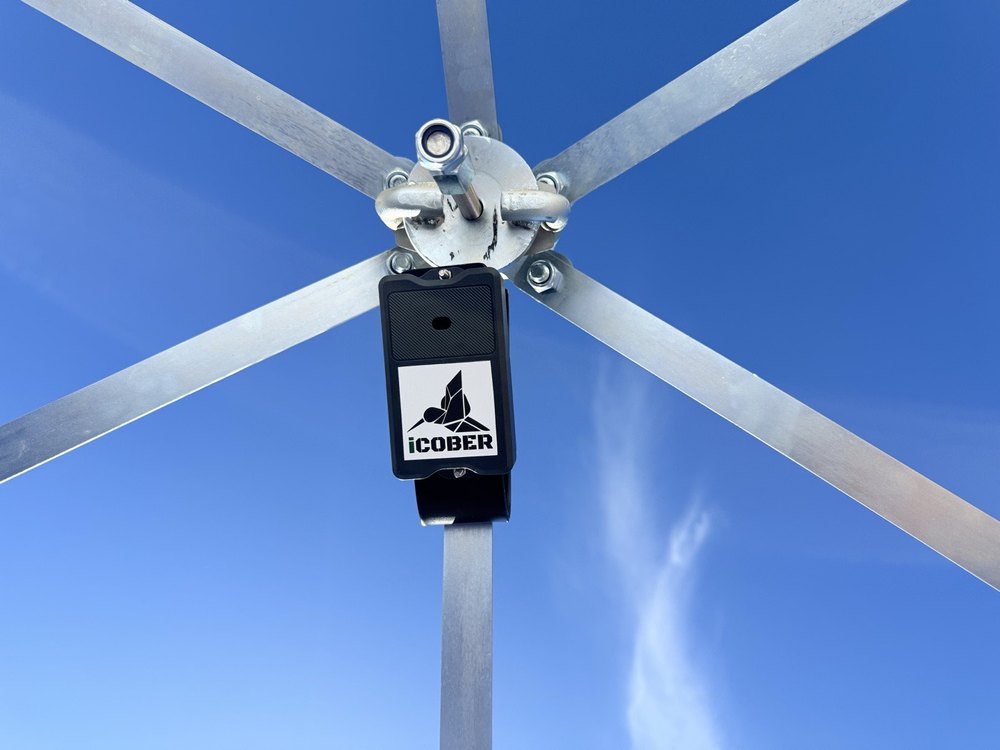
Our decision was driven by the environment in which the device is intended to operate: waste containers, including metal, underground and semi-underground systems with irregular waste surfaces.
We wanted to control the measurement area as precisely as practical and reduce the influence of structures outside that area. ToF fits that approach well.
In practice we use the STMicroelectronics VL53L4CX.
One measurement is still not enough
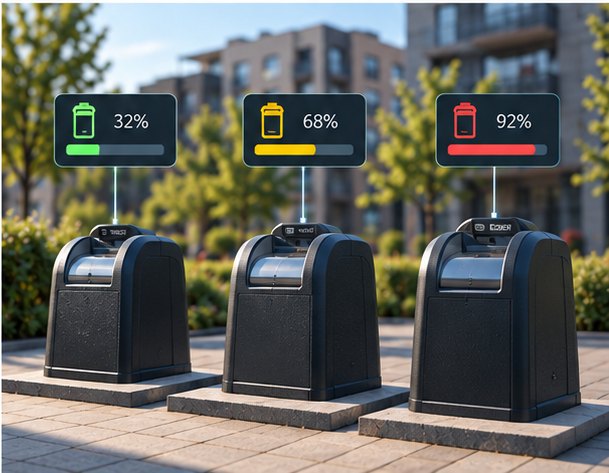
Choosing ToF does not solve another fundamental problem: waste does not form a flat surface.
A bag may protrude directly beneath the sensor. It may move later. The next item may fall beside it even though the actual occupied volume of the container has increased.
A single measurement should therefore not automatically become the new fill-level value.
The design of the sensor itself helps here. The VL53L4CX recognises several targets at once: if a protruding bag sits in the measurement area with the real waste surface below or behind it, the device sees both returns at different distances instead of stopping at the first one. We have this implemented and confirmed by our own measurements.
At iCober we analyse a series of measurements and their behaviour over time, rather than treating every individual reading as absolute truth. Only then does a distance measurement become useful information for an operator.
A good example is the textile container in Gdynia, where the contents naturally form a highly irregular surface.
What neither technology measures
Neither ultrasound nor ToF measures the mass of the waste. Both measure distance to the surface, from which the system estimates the fill level.
A container half-filled with lightweight packaging and another filled to the same height with heavy material may therefore report a similar fill level while having completely different weights.
Converting fill level into kilograms requires an additional model based on waste type and historical data. That is still an estimate, not a direct mass measurement.
The question is not simply "ToF or ultrasonic?". It is: what are we measuring, in what container and under what conditions?
How our solution works: Fill-level sensor — iCober Bin Sensor. How fill-level data changes collection planning: collection by fill level. More about using the data itself: Fill-level sensor — collection by state, not by calendar.
Technical sources: STMicroelectronics — VL53L4CX, MaxBotix — what affects ultrasonic sensor accuracy (mounting, beam width, obstacles and multiple echoes), acoustic reflections in curved steel containers, Sensors 2022.